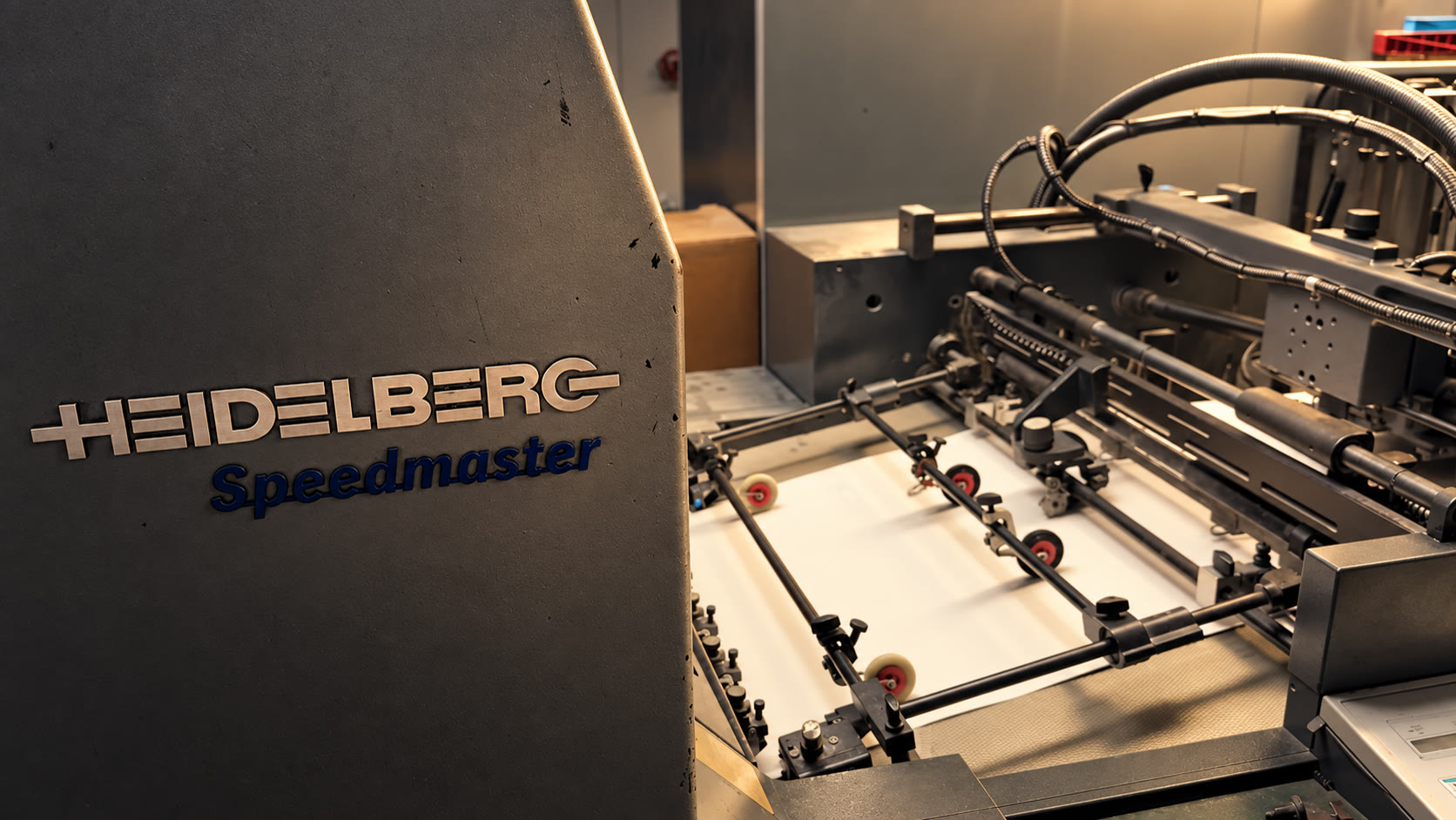
The place behind the paper
A real press.
A lasting impression.
Before a broadside reaches your wall, it belongs to a trade. Paper moving through a press. Type given weight in ink. A sheet inspected before it leaves the shop.
Thomas Broadside Co. brings the founding documents of America and the Western canon into the rooms where we live, learn, and work.
The Press
Sell provenance, not posters.
There are ten thousand three-dollar Declarations on the internet, and every one of them was made in a browser. What nobody else can sell is what we already own: a working press, a family that has printed in Austin for decades, and someone who will check the quotes.
The story is ours by trade. The Revolution was made by printers. Benjamin Franklin was one. On the night of July 4, 1776, John Dunlap set the Declaration in Caslon and ran roughly two hundred broadsides before dawn. Isaiah Thomas moved his press out of Boston days before Lexington and later wrote the first history of printing in America. No relation, same trade, and we say so.
A print shop that prints the founding documents is not a novelty store. It is the original business.
The three house rules
Cited
Every quote carries its source, date, and document, on the product page and on the sheet. If we cannot cite it, we do not print it. No spurious Jefferson.
Pre-partisan
The store belongs to the founding era, not to a party. The founding documents belong to everyone.
Printed here
Every physical print comes off our press in Austin and says so. Not print on demand. Not a fulfillment warehouse.
The family and the floor
Jacob E. Thomas, PhD
Chooses the documents, checks every citation against the archives, and keeps the store honest.
Ben Thomas
Runs the shop floor, the stock, and the shipping bench. If a tube reached you early with the label on straight, that was Ben.
David Olivo
Prints, inspects, and numbers every edition by hand. Nothing leaves the shop without passing his eye. Nothing ever has.
The information side of this shop (the catalog, the letters, the ledger) is kept by machines that read; every sheet, every price, and every claim of “cited” is approved by a human being.
Paper, inks, and the runs
Shipping. Rolled loose around a core, kraft-wrapped, capped, and shipped in a tube from Austin. Free in the U.S. on prints over $75; sets ship in one tube. Framing. Editions can be framed through our local framer before shipping; write the desk for the current rate.
Our sources
National Archives and Library of Congress transcriptions; portrait art from National Gallery of Art open access; maps from the Library of Congress; Texas documents from the Texas State Library and Archives. Every product page reads like a museum label: source, typeface, paper, press, edition. That label is the product.
Write the shop
A question, a wholesale inquiry, a school order, a quote you think we got wrong: the desk answers by letter within two working days.
History has a pulse / The director’s cut
The press makes words public.
The words become part of a life. From a Philadelphia print shop in 1776 to the presses working in Austin today, this film brings our founding story and the Western Canon into one frame.
Read the film transcript
The film opens on a still press image and narration. Real-speed press motion and sound begin after three and a half seconds.
History has a pulse.
Just listen.
In seventeen seventy-six, the Declaration entered a print shop. The words had to reach the people.
The spirit of printing transforms a working draft into a printed sheet.
And a voice carried farther.
The inheritance of printing reaches beyond the founding of America.
The search for wisdom.
The call to mercy.
The courage to find our way.
Here in Austin, we give enduring words a place on the page.
Ink. Paper. A working press. A tradition, carried forward.
Read the words.
Keep the source.
Make room for the enduring.
Thomas Broadside Company.
Words to live with.
About the images and sound
Twenty-five and a half seconds show our actual shop, drawn from four original recordings. The opening holds on a Heidelberg still for three and a half seconds under the title and narrator, then that same shot and its original sound play at real speed. The historical scenes are AI-assisted contemporary reconstructions; the Canon landscapes and reading room are visual meditations. They are not archival footage or claims about a specific biblical location.
A measured male synthetic narrator and an original AI-generated chamber score accompany the real machinery. No historical or sacred figure is given invented dialogue. The subtle covers identify the Odyssey, Matthew, and Dante through contemporary campaign designs, not historical facsimiles or separate book products. The closing images are the collection’s existing broadside designs.
Explore the history and its sources in The First Impression, and the texts and their sources in Words to Live With.